
What to expect
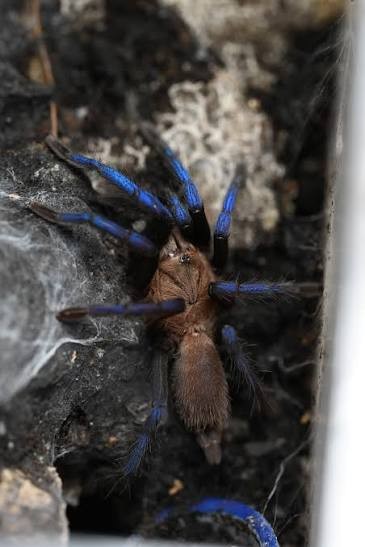
Neon Blue Legs come from Sarawak, Malaysian Borneo and are kept as fossorial tarantulas. Adults reach around 12–14 cm, with fast growth. In the UK hobby, the species is currently best described as uncommon.
Do not expect every Neon Blue Leg to behave identically. Appetite, retreat use, webbing and confidence in the open can vary between individuals, so use the species' normal lifestyle as a guide and adjust to the behaviour of the individual spider.
Enclosure setup
Neon Blue Legs are fossorial, so deep, compactable substrate is more important than a large open floor. Give the spider enough depth to build a stable burrow, with a piece of cork or a starter tunnel if you want to give it an obvious place to begin.
Once a Neon Blue Leg has established a burrow, leave it alone unless there is a genuine husbandry problem. Moved soil, webbing around the entrance and long periods out of sight are normal for a fossorial tarantula.
Temperature and room placement
A practical temperature range for Birupes simoroxigorum is 22–27 °C; avoid overheating deep burrows. Stable room conditions are more useful than chasing a precise number every hour. Check the shelf where the enclosure actually sits, especially during very warm weather and through winter.
For Birupes simoroxigorum, keep the enclosure away from direct sunlight, radiators and electronics that create local hot spots. Do not attach a heat mat directly to the enclosure; if the room is genuinely too cold, warming the room is easier to control than creating one concentrated hot surface.
Moisture, water and ventilation
For Neon Blue Legs, the moisture approach is straightforward. Use deep moisture-retentive substrate with a ventilated surface and dependable water source. You do not need every part of the substrate to be equally wet, and persistent condensation or a stale smell usually means the enclosure is staying too damp.
Keep a clean water dish available for Birupes simoroxigorum once the spider is large enough to use one safely. Smaller juvenile enclosures can dry faster than adult setups, so adjust how often you add water to the actual drying rate rather than following a fixed calendar.
Feeding
Feed Neon Blue Legs according to their size, appetite and abdomen rather than a fixed weekly schedule. Use established feeder insects that the spider can overpower without a long struggle, and remove live prey if it is ignored.
Young spiders usually eat more regularly while they are growing. Adults can go much longer between meals. If Birupes simoroxigorum begins refusing prey and spends more time hidden, premoult is one of the first normal explanations to consider.
Growth and moulting
Growth in Birupes simoroxigorum is fast. Young Neon Blue Legs generally moult more often than large juveniles and adults, and appetite often changes as a moult approaches.
During premoult in Birupes simoroxigorum, remove live prey and keep fresh water available. After a moult, leave the spider undisturbed until the new exoskeleton has hardened and the fangs have darkened before offering food again.
Temperament and safe maintenance
Neon Blue Legs should be treated as hands-off animals. Use long tools for maintenance, keep a catch cup ready when rehousing and assume the spider may move quickly when the enclosure is opened.
Do not use handling as part of routine care. With an Old World species such as Birupes simoroxigorum, good enclosure design matters because it lets you refill water, remove leftovers and carry out maintenance without forcing close contact.
Male and female lifespan
Male Birupes simoroxigorum are generally expected to live around 2–3 years, while females can live 8–10 years. These are broad captive ranges, not exact lifespans, and individual growth history can shift maturity earlier or later.
Female Birupes simoroxigorum continue moulting after maturity. A mature male eventually reaches his ultimate moult and may become more active around the enclosure while feeding less often. Keep moult dates if you want a clearer picture of age, growth and sex over time.
UK availability and naming
In the UK hobby, Neon Blue Legs are currently classed as uncommon. Availability can change quickly between specialist stock lists, captive-produced batches and show weekends, so treat that label as a guide rather than a promise that a particular size or sex will always be easy to find.
When buying a Neon Blue Leg, confirm the scientific name as well as the common name. Common names can be reused or changed in the hobby, while Birupes simoroxigorum is the more reliable identifier for care records and future reference.
Long-term care
Long-term care for Birupes simoroxigorum is mostly about consistency. Keep the enclosure secure, maintain fresh water, feed sensibly, respect the spider's retreat and make changes only when the setup stops working for the animal.
Rehouse a Neon Blue Leg when the existing enclosure has genuinely become cramped or awkward to maintain, not simply because the spider touches the walls. Prepare the new enclosure completely before moving the spider so the transfer itself can be kept short and controlled.